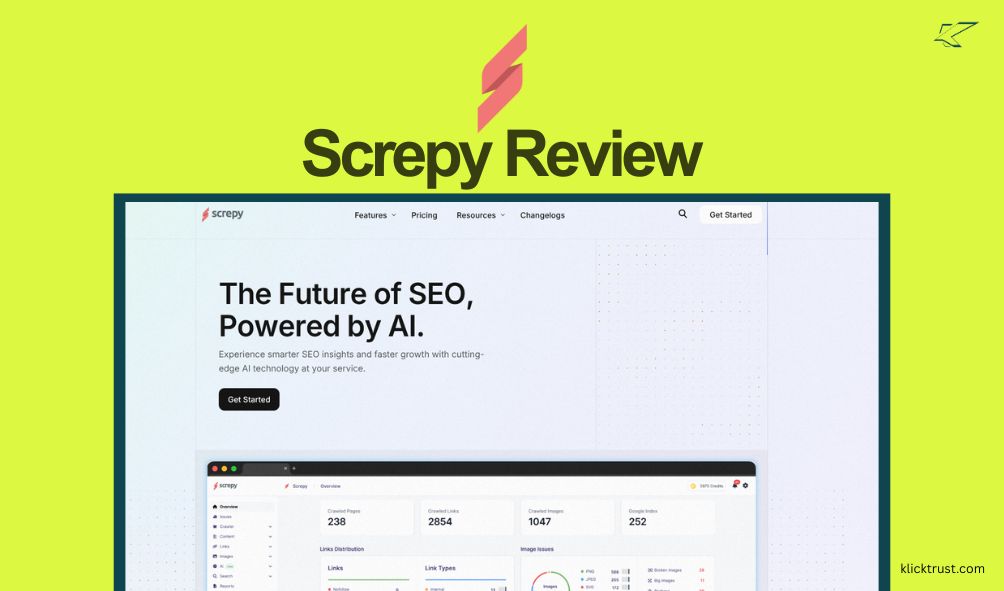
We’ve all been there—staring at a complex dashboard, wondering why our website traffic just tanked. Is it a broken link? A slow page? Or did Google just change its mind again? Managing website feels like spinning plates. If you drop one, the whole show stops. That’s why I decided to test out a tool that promises to make this easier.
In this Screpy review, I’m going to walk you through everything I found after using the tool for my own projects. I’ll share the good, the bad, and the frustrating. By the end, you’ll know if this all-in-one SEO tool is the right fit to help you stop guessing and start growing your online presence. Let’s dive in.
What is Screpy?
Screpy is an AI-powered web analysis tool designed to be your website’s personal health monitor. Think of it as a doctor for your site that never sleeps. It combines several critical tools into one simple dashboard. Instead of paying for five different subscriptions, Screpy attempts to do it all in one place.
It focuses on four main pillars: SEO monitoring, Page Speed tracking, Uptime monitoring, and Syntax validation. The goal is simple. It wants to help website owners, marketers, and developers identify issues before they hurt rankings. It scans your pages, finds the problems, and tells you exactly how to fix them. No jargon, just tasks.
First Impressions and Setup
I have to be honest—I was skeptical. Most “all-in-one” tools are a master of none. But setting up Screpy was refreshingly simple. I didn’t need to install complex code or hire a developer. I just entered my domain URL, and the tool got to work immediately.
The dashboard is clean and minimal. You don’t get overwhelmed with charts and data you don’t understand. Within minutes, I saw my site’s health score. It felt like playing a video game where you want to get your score to 100. It wasn’t scary; it was actually kind of fun.
Key Features and How to Use Them
Let’s break down the main features. This is where the rubber meets the road. I tested each of these extensively to see if they actually provide value or just look pretty.
SEO Monitoring
This is the bread and butter of the tool. Screpy crawls your site just like Google does. It looks for common issues that kill your rankings. I’m talking about missing title tags, bad meta descriptions, and broken links.
My Experience:
When I ran my first audit, I was shocked. I had three pages with missing H1 tags. I had no idea. Screpy flagged them and created a “task” list. I clicked on a task, and it showed me exactly where the error was. It felt like having an SEO expert sitting next to me, pointing at the screen.
Uptime Monitoring
Your website is useless if no one can see it. Uptime monitoring checks your site every few minutes to make sure it’s online. If it goes down, you need to know before your customers do.
My Experience:
I set this up to ping me via email. Thankfully, my host is pretty good, so I didn’t get many alerts. But I did simulate a downtime to test it. The alert came through almost instantly. Knowing that Screpy is watching my back 24/7 gives me serious peace of mind.
Page Speed Monitoring
We all hate slow websites. Google hates them too. Screpy integrates with Google Lighthouse to track your speed. It doesn’t just give you a score; it tracks that score over time.
My Experience:
My homepage was loading at a snail’s pace on mobile. Screpy showed me a historical graph of my speed dropping. It pinpointed a large image file I uploaded last week as the culprit. I compressed the image, and my score shot back up. Seeing that green line go up on the graph was incredibly satisfying.
Syntax Validation
This sounds technical, but it’s important. It checks your code to make sure it’s clean and readable for search engines. Messy code can confuse bots and hurt your ranking.
My Experience:
I’m not a coder. So, seeing a list of “syntax errors” was intimidating. However, Screpy explains what the errors are. While I couldn’t fix all of them myself, I was able to send a clear list to my developer. He fixed them in an hour. It streamlined communication perfectly.
Pros and Cons
Nothing is perfect. Here is my honest take on where Screpy shines and where it falls short.
The Good Stuff
- User Interface: It is incredibly easy to use. You don’t need a PhD in SEO to understand it.
- Task-Based Workflow: I love that it turns problems into a to-do list. It makes SEO actionable.
- All-in-One Value: Getting uptime, speed, and SEO tools in one sub is a great deal.
- Keyword Tracking: You can track how you rank for specific terms, which is super helpful.
The Not-So-Good Stuff
- Keyword Limits: The lower-tier plans have tight limits on how many keywords you can track.
- Less Depth than Giants: It’s not as deep as Ahrefs or SEMrush for backlink analysis.
- Support: The documentation is okay, but I’d love to see more video tutorials.
Pricing
Screpy offers a few tiers. They often have lifetime deals on platforms like AppSumo, but let’s look at their standard monthly pricing.
- Lite Plan ($15/month): Good for beginners. You get 2500 credits and can track a handful of keywords. It’s great for a personal blog.
- Pro Plan ($45/month): This is the sweet spot. You get more credits (8000) and can track way more keywords. Perfect for freelancers.
- Advanced Plan ($89/month): Built for agencies. You get massive limits and priority support.
Get 71% Off in Appsumo Lifetime Deal from here.
Is it worth it?
If you bought separate tools for uptime, rank tracking, and auditing, you’d pay over $100 easily. For the price, Screpy is a steal, especially for small business owners.
Who is Screpy For?
This tool isn’t for everyone. If you are a massive enterprise with a dedicated SEO team, you might need something more robust like Ahrefs.
However, Screpy is perfect for:
- Small Business Owners: You need to manage your own site without hiring an agency.
- Freelancers: You manage a few client sites and need a simple way to report progress.
- Solopreneurs: You wear all the hats and need a tool that saves you time.
- Web Developers: You want to hand off a perfectly optimized site to your clients.
Real-World Use Cases
Let me tell you about a friend, Sarah. She runs a local bakery. She had a nice website, but zero traffic. She used Screpy and found out her images were huge, slowing her site down. She also found that her “Menu” page had a broken link.
She used the checklist to fix the images and the link. Within two weeks, her local rankings improved. She started getting more calls for custom cakes. It wasn’t magic; it was just fixing the basics that she didn’t know were broken. Screpy made that invisible stuff visible.
Alternatives to Screpy
It’s always good to shop around. Here is how Screpy stacks up against the big guys.
- Ahrefs/SEMrush: These are the gold standards. They are powerful but expensive and complex. If you need deep backlink research, go here. If you need on-page fixes and monitoring, stick with Screpy.
- Ubersuggest: A solid alternative that is also budget-friendly. It focuses more on keyword research than technical monitoring.
- Google Search Console: It’s free, which is great. But it doesn’t give you the step-by-step “how to fix it” advice that Screpy does.
FAQs
Is Screpy easy to use for beginners?
Yes, absolutely. That is its biggest selling point. The dashboard is intuitive, and it explains technical terms in plain English. You won’t feel lost.
How accurate is Screpy’s data?
It uses Google’s own Lighthouse API for speed and trusted sources for rankings. In my experience, the data matches up well with other premium tools.
Does Screpy offer customer support?
Yes, they have a support team and a knowledge base. They usually reply fairly quickly, though it’s not instant live chat 24/7.
Is Screpy worth the investment?
For the time it saves, yes. Identifying one downtime incident or fixing one major SEO error can pay for the subscription for the whole year.
Final Verdict
So, is Screpy worth it? If you want to improve your website without getting a headache, then yes. It simplifies the scary world of SEO. It gives you a clear plan of attack. You stop guessing and start fixing. It’s not the most powerful tool on earth, but it doesn’t try to be. It tries to be the most helpful one for the average user. And I think it succeeds.
Don’t let your website issues hide in the dark. Shine a light on them. Give Screpy a try and see how green you can get that health score. Your future traffic will thank you.

Hi, I am the founder of KlickTrust. I’m a digital strategist and builder with a deep passion for creating systems that help people build faster online. I started KlickTrust to save creators, freelancers, and entrepreneurs from wasting months starting from scratch by giving them access to practical, ready-to-use digital tools, templates, and automation systems that actually work in the real world.
At KlickTrust, I focus on speed, trust, and empowerment, so you can launch, grow, and scale with confidence.